
How Arrest Warrants Work in Pipestone County
A Pipestone County arrest warrant is a judge's order allowing police to take someone into custody on a charge. It starts with a complaint. Minnesota Rule of Criminal Procedure 3 governs how that process issues, what it must contain, how it is served, and what happens when it is defective. The judge signs the order. The sheriff acts on it. Public access comes in layers. The Pipestone County Sheriff's Office posts a short active table, but that table is not the warrant instrument. It leaves out the issuing judge, the legal basis, and the service date. Those details sit in the court file at Pipestone County District Court.
Arrest Warrants: What They Contain
The warrant and the complaint are separate documents. A Pipestone County warrant is the shorter one, and the state's rule headings and model forms show what appears on the order itself.
| Court and County | The Pipestone County District Court, where the charge was filed |
|---|---|
| Case File Number | District Court file number, printed as 59-CR-00-0000 style text |
| Defendant | The named person, with identifying detail the court used |
| Offense | The charge supporting the request, not the full complaint |
| Order to Officers | Language directing the Pipestone County Sheriff or an authorized person to arrest |
| Appearance Requirement | Directions on prompt appearance before a judge after arrest |

The county website gathers the offices a Pipestone County warrant question touches: the Sheriff's Office, court administration, and city links. Each holds a different piece of the record.
The Pipestone County Arrest Warrant Record
No Pipestone County arrest warrant issues without probable cause. A judge makes that finding on a written application, never on a hunch. The affidavit behind it is often the least public document in the file. Search warrant affidavits can be sealed. Arrest warrant index data carries its own confidentiality rule under section 13.82, subdivision 19, which holds until custody, service, or appearance. What stays public? Usually a Pipestone County reader can see the complaint, the docket, and the case status. Minnesota's public access rule presumes case records are open. A rule, statute, or order can restrict parts. What remains visible still carries useful information.
How Warrants Get Served in Pipestone County
The Pipestone County Sheriff's Office handles service. It executes process, publishes the active table, and holds custody information. City police work through the same office under contract. So a city-originated case still lands with deputies or contracted officers. Beyond that, the details run thin. Pipestone County posts no warrant-unit name, no service-hours schedule, and no walk-in surrender window. To learn whether process has been served, call the Pipestone County Sheriff's Office at 507-825-1100 and ask.
Pipestone County Warrant Issuance and Custody
Four offices touch a Pipestone County arrest warrant. Knowing which one does what saves a wasted trip. The Pipestone County District Court issues the order and sets conditions. The prosecutor brings the charge. The Sheriff's Office serves the warrant, transports, and holds custody. Court Administration keeps the file and the calendar and can explain procedure, though not give legal advice. The Pipestone County jail shares a building with the courthouse at 416 S. Hiawatha in the county seat, and the 2025 state inspection describes a secure court holding area there. Close geography does not merge the offices, so a release question goes to the jail or the court, not a city office.
Arrest Warrants, Summonses, and Bench Warrants
The three documents differ in when they appear and what they authorize.
| Document | When It Appears | What It Authorizes |
|---|---|---|
| Summons | At the start of a case, issued with the complaint | Court appearance without an arrest command |
| Arrest warrant | After a probable cause finding on a filed charge | Custody and transport to court |
| Bench warrant | After a missed court obligation in an open case | Enforcement of the court's order, sometimes with new notice instead |
Minnesota treats summons and warrant issuance in one rule. Between them sits the Pipestone County sign-and-release warrant under section 629.415. It demands no bail. Under the statute's conditions, it does not authorize arrest either.
No Published Warrant Hours for Pipestone County
Pipestone County publishes no warrant desk hours, walk-in surrender schedule, or bond window. The Sheriff's page lists a general phone number, a fax number, and an email address. It names the Sheriff. It names no warrant division and no service hours. The jail page covers visiting, mail, and message rules, and its visiting hours are not surrender hours. Neither the Pipestone County list nor a records request can promise a walk-in window exists. Plan to ask by phone. Expect an answer that depends on the case.
Handling an Arrest Warrant in Your Name
A warrant in your own name is a legal problem before it is a records problem. Call a Minnesota attorney first, not a search box. Counsel can pull the complaint, see whether the Pipestone County charge is still pending, and advise on timing.
Before You Act: Minnesota's criminal-help guidance says a person who believes a warrant exists can contact the Pipestone County Sheriff's Office or the court, and warns that appearing may result in custody. Ask about bond, release conditions, and whether counsel can arrange the first step.
Practical steps come after the legal advice. Confirm the court and file number. Ask what bond type the order carries, and keep proof of any appearance. Paying online clears no arrest warrant on its own, in Pipestone County or anywhere else.
Federal Warrants Outside the Pipestone County List
Federal criminal cases never touch the Pipestone County warrant table. They sit with the U.S. District Court for the District of Minnesota, and a federal warrant stays sealed unless a court order unseals it. Once unsealed, you can read it at a public terminal in the Clerk's Office, a route entirely separate from MCRO. PACER, the federal docket system, opens case records where they are public. The U.S. Marshals Service district covering Pipestone County posts no profiled-fugitive roster.
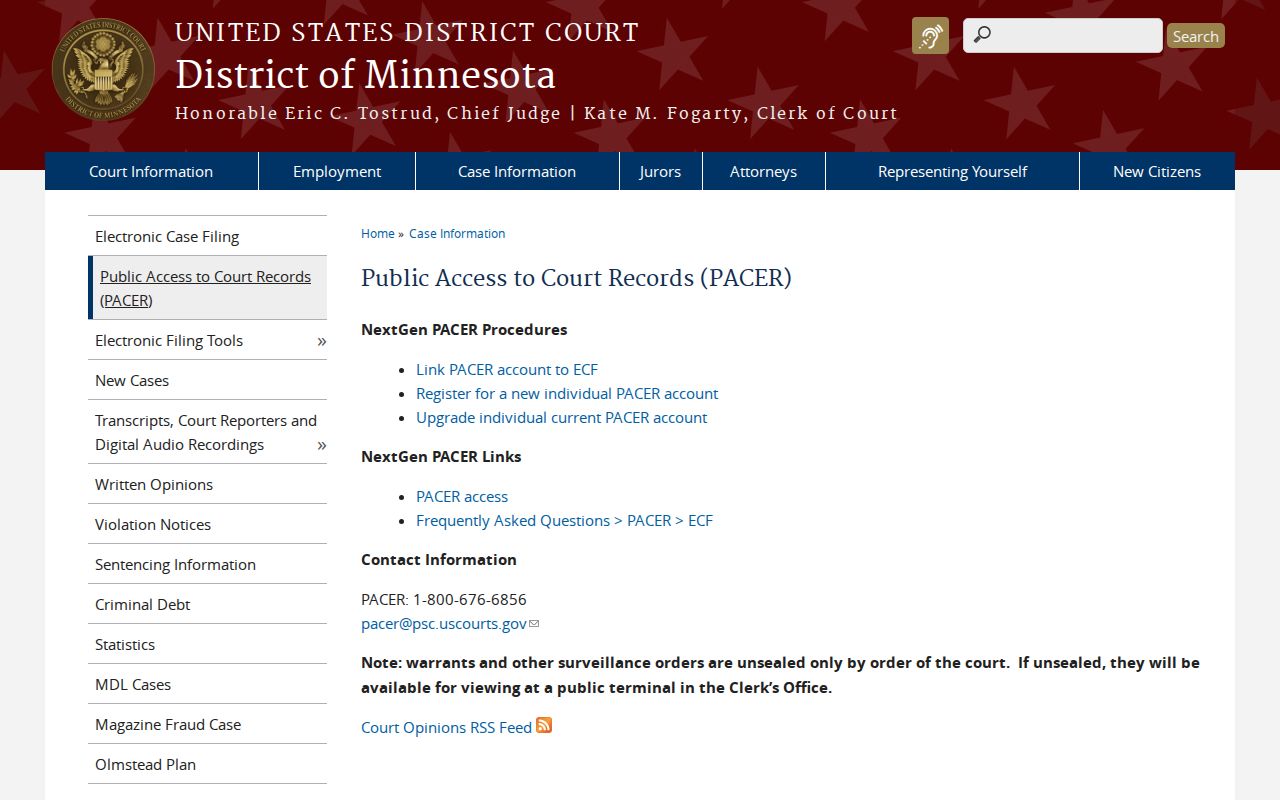
The District of Minnesota PACER page states the sealing rule in plain terms. That rule is why no public federal warrant list exists for a Pipestone County check.